CASE STUDIES

What we've uncovered — before it was too late.

All cases are anonymised. Details adjusted where necessary. Every situation below would have resulted in a bad decision without proper verification.

Joint Venture | Indonesia

Hidden Shareholder Risk

01
context

A Singapore-based investor was entering a joint venture in Indonesia.

Deal size: ~USD $4M
Structure: Two shareholders — both known and verified parties
What looked normal
  • Clean ownership structure
  • Recognised investor on cap table
  • Proper legal documentation
  • No visible disputes in initial checks
How we investigated
  • Reviewed historical shareholder filings
  • Analysed nominee ownership patterns
  • Cross-checked related-party relationships
  • Pulled litigation records across jurisdictions
what we uncovered
  • An undisclosed minority shareholder hidden via nominee structure
  • This individual had prior disputes in two jurisdictions
  • Side agreements created uneven control and exit risk
  • True influence did not match disclosed ownership
What would have happened

Client would have entered a partnership with a hidden counterparty carrying legal and reputational risk.

outcome

Client renegotiated terms before signing.

Acquisition | Vietnam

Strong revenue — weak reality

02
Context

A regional buyer was evaluating an SME acquisition.

Deal size: ~USD $2M
Claim: Steady growth and strong financials
What looked normal
  • Clean management accounts
  • Consistent revenue growth
  • Positive supplier narrative
  • No major legal flags
How we investigated
  • Compared tax filings vs reported numbers
  • Verified supplier relationships
  • Checked operational scale vs claimed revenue
  • Cross-referenced activity signals
what we uncovered
  • ~60% gap between reported revenue and actual activity
  • Key supplier relationships overstated or non-existent
  • Business scale inconsistent with financial claims
What would have happened

Client would have overpaid significantly for a business that did not match its numbers.

outcome

Client walked away before committing capital.

Cross-Border Acquisition | Thailand · Singapore

What looked like one company — was actually four

03
CONTEXT

A buyer was acquiring a company operating across multiple countries. Structure presented as a single-entity acquisition.

What looked normal
  • Clean deal structure
  • Standard acquisition documents
  • Proper legal documentation
  • No obvious issues in initial review
How we investigated
  • Mapped ownership across jurisdictions
  • Reviewed offshore holding layers
  • Checked legal exposure across entities
  • Verified regulatory standing
what we uncovered
  • True ownership routed through a Cayman holding layer
  • Exposure across multiple undisclosed entities
  • Ongoing arbitration not disclosed
  • Regulatory inconsistencies across jurisdictions
What would have happened

Client would have unknowingly taken on liabilities outside the visible deal structure.

outcome

Client restructured the transaction before proceeding.

Project Investment | Indonesia

A “live” project that had already stopped

04
context

An investor was considering funding a development project.

Deal size: ~USD $3M
Pitch: Active construction in progress
What looked normal
  • Site photos showing partial build
  • Timeline indicating progress
  • Confident local partner
How we investigated
  • Conducted physical site visits
  • Observed activity levels across multiple days
  • Spoke with nearby businesses and workers
  • Compared historical vs current site condition
what we uncovered
  • Site had been inactive for over 12–18 months
  • No active construction or workforce
  • Contractors had disengaged
  • Local consensus: project had stalled long ago
What would have happened

Client would have funded a project that was no longer progressing.

outcome

Client withdrew before investing.

SME Acquisition | Vietnam

Revenue on paper — cash missing in reality

05
context

A buyer was acquiring a growing SME.

Deal size: ~USD $1.5M
Structure: Two shareholders — both known and verified parties
What looked normal
  • Strong reported revenue
  • Positive growth trajectory
  • Clean financial summaries
How we investigated
  • Analysed receivables and payment cycles
  • Checked supplier payment behaviour
  • Pulled litigation records across jurisdictions
what we uncovered
  • Business was highly illiquid
  • Large portion of revenue tied up in uncollected receivables
  • Suppliers were being paid late
  • Cash flow pressure masked by growth
What would have happened

Client would have acquired a business requiring immediate capital injection.

outcome

Client renegotiated valuation and deal terms.

Distributor Appointment | Thailand

A “regional player” with no real backbone

06
context

A company was appointing a distributor in Thailand.

What looked normal
  • Strong brand presence
  • Claimed distribution network
  • Confident sales positioning
How we investigated
  • Mystery shopped the business
  • Verified warehouse and logistics activity
  • Assessed staff and operational scale
what we uncovered
  • No real warehousing or logistics capability
  • Fully dependent on third parties
  • Operating more as a broker than a distributor
What would have happened

Client would have relied on a partner without execution capability.

outcome

Client restructured agreement and reduced exposure.

Partnership | Malaysia

Clean records — bad reputation

07
context

A company was entering a long-term partnership.

What looked normal
  • No litigation
  • Established local presence
  • Clean formal records
How we investigated
  • Conducted local reputation checks
  • Spoke with suppliers and nearby operators
  • Gathered informal market feedback
what we uncovered
  • Pattern of late payments
  • Ongoing informal disputes
  • Known locally as difficult to work with
What would have happened

Client would have entered a high-friction partnership with ongoing operational issues.

outcome

Client chose not to proceed.

Fundraising | Singapore · Indonesia

Capital raised — execution missing

08
context

An investor was evaluating participation in a funding round.

What looked normal
  • Strong growth narrative
  • Previous funding secured
  • Professional materials
How we investigated
  • Tracked prior capital deployment
  • Reviewed project timelines vs delivery
  • Assessed actual execution progress
what we uncovered
  • Previous funds produced minimal tangible output
  • Projects repeatedly delayed or abandoned
  • Pattern of raising ahead of execution
What would have happened

Client would have invested into a company with weak execution track record

outcome

Client declined participation.

testimonials

Customer Testimonials

Our clients are at the center of everything we do. We consider each project not just a construction endeavor, but a collaborative journey with you.

We were ready to proceed with the acquisition based on what we had reviewed internally. Their investigation surfaced ownership inconsistencies and ongoing legal exposure that hadn’t been disclosed. It completely changed our view of the deal and ultimately saved us from a costly mistake.”

James Carter, Investment Director

They uncovered relationships and risk factors that wouldn’t appear in any standard due diligence process. Having that level of clarity allowed us to renegotiate from a much stronger position, with a clear understanding of what we were actually taking on.

Lina Tan, Private Equity Associate

What stood out was their ability to verify things that are usually inaccessible. They went beyond surface-level checks and gave us a view into how the business actually operates on the ground. That insight is difficult to find elsewhere.”

David Lim, Family Office Principal

Discretion was critical for us, and they handled it exactly as needed. The work was thorough, well-structured, and grounded in local reality. We now involve them whenever we’re evaluating opportunities in markets where visibility is limited.

Omar Haddad, Corporate Lead

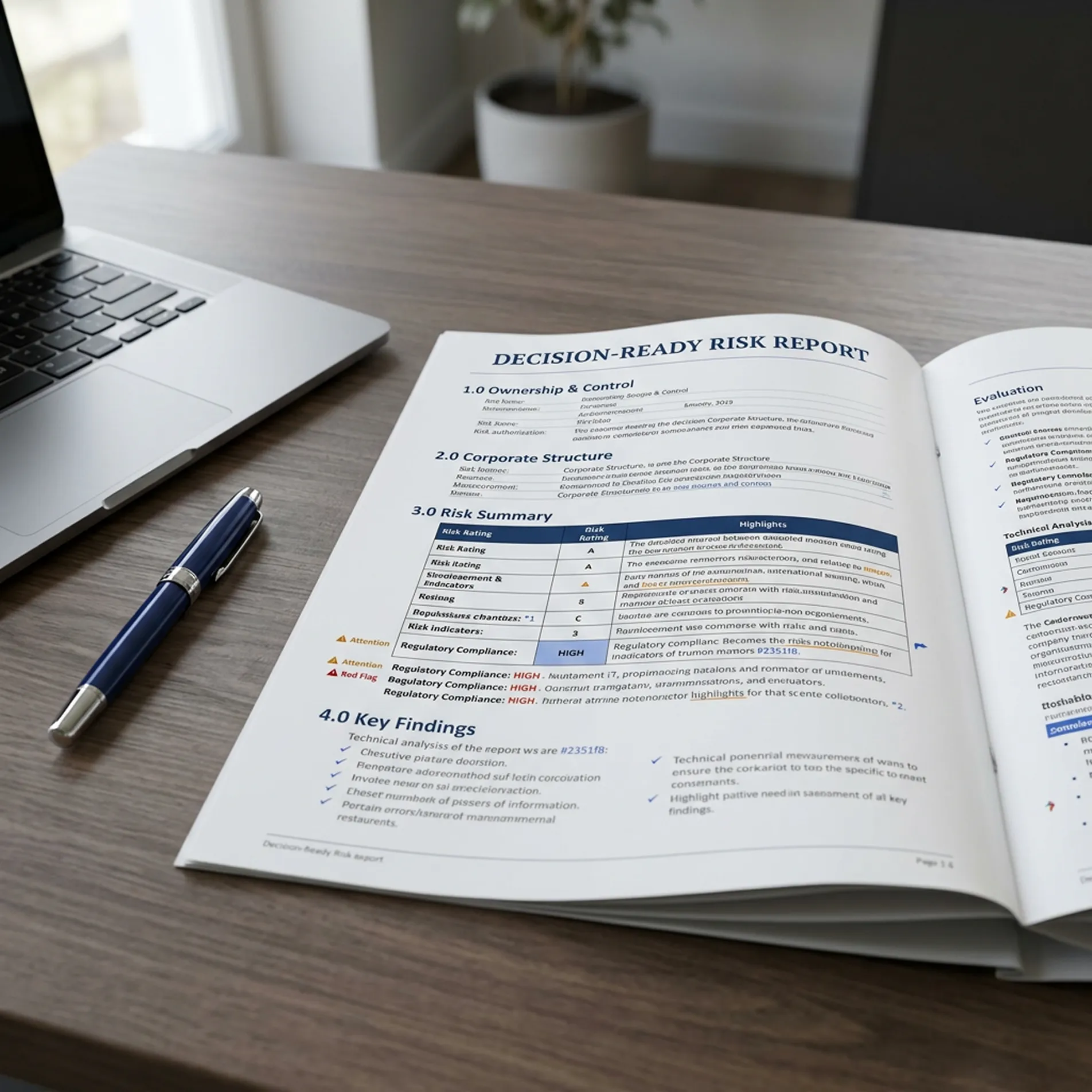
The report was clear, direct, and genuinely useful. It didn’t just highlight risks—it explained the implications behind them and how they could impact the deal. That made it far easier for us to make a confident decision.
Rachel Nguyen, Venture Partner

We decided to walk away from a deal based on their findings. At the time, it was a difficult call, but in hindsight it protected us from significant financial and reputational risk. That alone made the engagement worthwhile.

Marcus Lee, Managing Director

We had already completed standard due diligence and everything appeared in order. Their work revealed gaps between what was presented and what actually existed on the ground. That additional layer of insight changed how we approached the transaction.

Andrew Koh, Investment Manager

What they delivered went far beyond verification. It gave us a clear, on-the-ground understanding of the people, structure, and risks behind the deal. That level of clarity is rare, and it directly influenced our decision-making.
Sarah Lim, Strategy & Investments Lead